

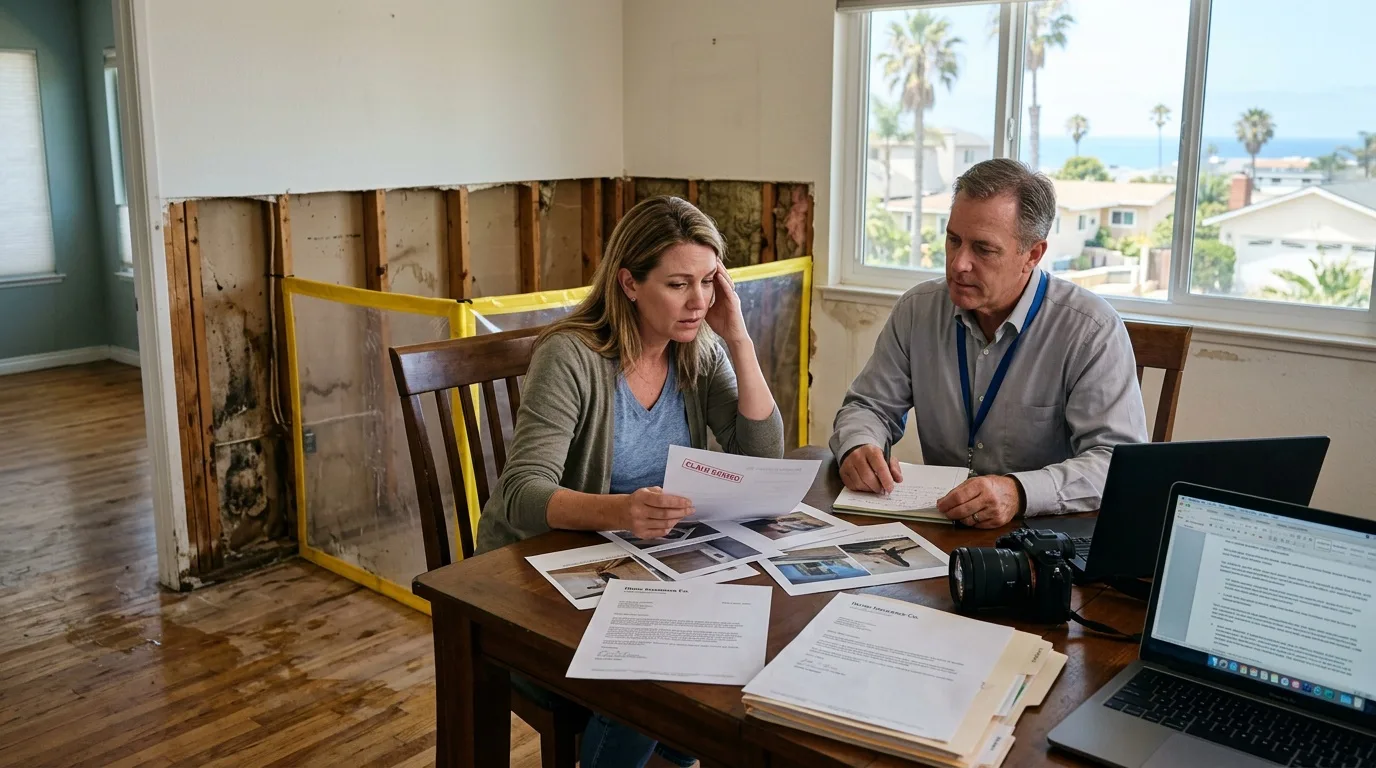
Water came through the ceiling or up through the floor, you filed with your insurer, and the answer came back as a no. In practice, a water damage claim denied by the insurer is not rare. Insurers often turn these claims down. Even when the damage was properly documented, the company may still refuse to pay, and the reasons usually come down to a handful of standard situations.
Below we go over the most common reasons a homeowners insurance water damage claim gets denied, what to look for in the denial letter, which documents help, and how to ask for a review. First, the usual order of things.
How a Water Damage Claim Normally Goes
- Record the damage. Take photos and notes, and get the source of the water identified and written down.
- Notify the insurance company within the time set in your policy.
- Wait for the adjuster. The insurer comes out and assesses the damage, then you submit the documents for the claim and the insurer decides on it.
Problems tend to show up at each of these steps. Can you file an insurance claim for water damage after the fact, or with gaps in the paperwork? Sometimes, but this is exactly where most refusals start.
Common Reasons a Water Damage Claim Is Denied
Late notice to the insurer
For example, you reported to the insurer two weeks later, while the policy clearly calls for prompt notice. To avoid this, call the insurer on the day of the incident and send written notice the next day.
The short reporting window is not just a whim of the insurer. It exists so the company can inspect the loss while the evidence is fresh. Missing the deadline does not by itself always mean the claim is lost for good, but disputes over late notice can drag on for a long time. It is simpler not to miss the deadline.
Slow leak, wear and tear, and maintenance
The company may decline to treat a specific event as covered, based on the terms of the policy. One typical case: the damage came from something that was already wearing out. If the home is old and its pipes, fixtures or framing were deteriorating before the policy was written, the insurer may take the position that the damage began before coverage and is not owed. This is the "wear and tear" reason you may see in a denial letter.
The same goes for a gradual leak not covered under the policy: water that ran slowly over weeks or months, under a sink or behind a wall, is often treated as long-term exposure rather than a sudden event. Long, gradual exposure is commonly listed directly among the exclusions.
Seepage and water from outside
Policies often list which systems and which kinds of water entry they cover. Water that gets in through the roof, walls, windows or doors may fall outside the covered risks. Read the list of covered risks and the exclusions section carefully, so you know what applies before a dispute starts.
Flood and earthquake
Flood and earthquake are the usual exclusions in a standard homeowners policy; coverage for them is bought separately. So a flooded lower level can be refused on these grounds.
Mold limits
Mold that grows after a leak is often treated separately, with its own limits or exclusions in the policy. If the mold is the result of a long, slow leak, the insurer may point to both the gradual leak and the mold terms. Mold growth is one more reason not to wait with drying; see our mold removal and remediation services for what that work involves.
Damage the policy does not cover
A loss can be refused because it happened as a result of actions the policy does not cover. These include deliberate acts.
Failure to limit the damage
Another reason for refusing or reducing a payment is not taking steps to reduce the damage. For example, no attempt was made to save the property, such as expensive furniture. Your records should state what specific steps you took to keep the damage down: wiping the floors, setting out containers to catch water, moving furniture.
Overstated damage or missing proof
Problems can also come from an inflated damage amount or a lack of proof. A frequent difficulty is not having evidence that the damaged property, such as electronics, was actually in the home. Photos or videos taken before the incident, in which the items are visible, help here. A properly prepared independent damage estimate is also important evidence.
Errors in documents matter as well. It is one thing if there is a typo on the claim form, and quite another if the information is knowingly false, for example an inflated damage amount.
Reading the Denial Letter
A refusal should come in writing and state its reasons. Read it next to your policy. You need to start from the reason for the refusal and understand what to do in each specific case.
- Find the exact clause. Note which exclusion or condition the insurer cites, and compare its wording with the policy text.
- Check what can be fixed. Insurers name reasons such as an incomplete set of documents, incorrectly filled out forms, or not recognizing the event as covered. If the reason can actually be removed, remove it and file again.
- Separate small errors from real disputes. Minor inaccuracies can often be settled directly with the insurer by reissuing or adding the missing documents.
A claim can also be underpaid rather than refused. There are different ways payments get reduced: a lower value put on the property, separate items removed from the list, and so on. Insurers may point to depreciation of property, insufficient evidence or mistakes in documents.
Documents That Help
A key part of any claim is getting all the necessary paperwork right. A typical package includes:
- The claim form and a copy of the policy;
- Photos and video of the damage, and older ones showing the property before the incident;
- A written record of the cause, such as the plumber's report naming the source of the leak and the date it was found;
- Moisture readings and drying records from the water damage work;
- Invoices and receipts for repairs and emergency work;
- An independent damage estimate, if you have one;
- Your correspondence with the insurer, including any earlier requests.
For the property itself, list each item with its level of damage. Get a detailed description of every single item of damage, without exceptions. Make sure the record states the cause and the source of the water, and the date.
If belongings had to be moved out while the home dries, keep the inventory from that work too. Our guide to how a pack-out works explains how items are listed and stored, and the contents pack-out and storage service page covers the service itself.
Asking for a Review in Writing
When the insurer refuses to pay or deliberately lowers the amount, send a written request explaining why you disagree, along with a copy of the independent estimate. This is the usual first step of an insurance claim denied appeal.
- Send it in a way you can prove. Keep a copy of the letter and of everything attached, with the date it was sent.
- Answer the stated reason. Point to the policy wording and to your documents for each point of the refusal.
- Do not use the insurer's own estimator for the second opinion. If you are unhappy with the insurer's decision, the estimate for your request should not come from the same company.
How claims must be handled in this state is set by California's Fair Claims Settlement Practices Regulations. It is worth reading them before writing to the insurer.
Getting Help
If the request to the insurer did not help, the next step is outside help.
- The state regulator. The California Department of Insurance regulates insurers and takes complaints from consumers. The California Department of Insurance consumer guides for residential property explain the claim process and how to file a complaint.
- A lawyer. Insurance companies, as a rule, use experienced lawyers and experts. If the dispute cannot be settled out of court, filing a lawsuit is what is left, and here proper legal support matters.
- Your contractor's records. The documents from the water damage work, moisture readings and photos, are often what a second look is based on.
If the refusal is not resolved, it is worth checking the policy, the incident records and the insurer's letter together, and consulting an attorney if there is any doubt. Before you choose who will do the work, you can read about our San Diego restoration team and what local homeowners have said.
Fixing Slow Leaks Fast
What to do if water is getting into the home:
- Cut the power to the wet area or the whole house by switching off the breakers in the electrical panel, if you can reach it without stepping into water; if not, call an electrician.
- Cover floors and furniture with plastic sheeting.
- Find where the leak is coming from and shut off the water. If you cannot find it, call a plumber.
- Write down every step you take to limit the damage, with photos.
Before stepping into a room with standing water, shut off the power to that area. Water and live wiring together are dangerous.
A slow leak left alone is the classic reason for a "gradual leak" denial, and the longer it runs, the more of the damage the insurer may treat as wear rather than a sudden event. If water has reached a lower level, read what to do first when your basement floods. For extraction and drying, see our water damage restoration in San Diego, or start from the restoration company home page.
Insurance claim denied, what to do? Keep it simple: report on time, record everything, read the refusal closely, answer it in writing, and fix the next leak before it becomes a slow one.