

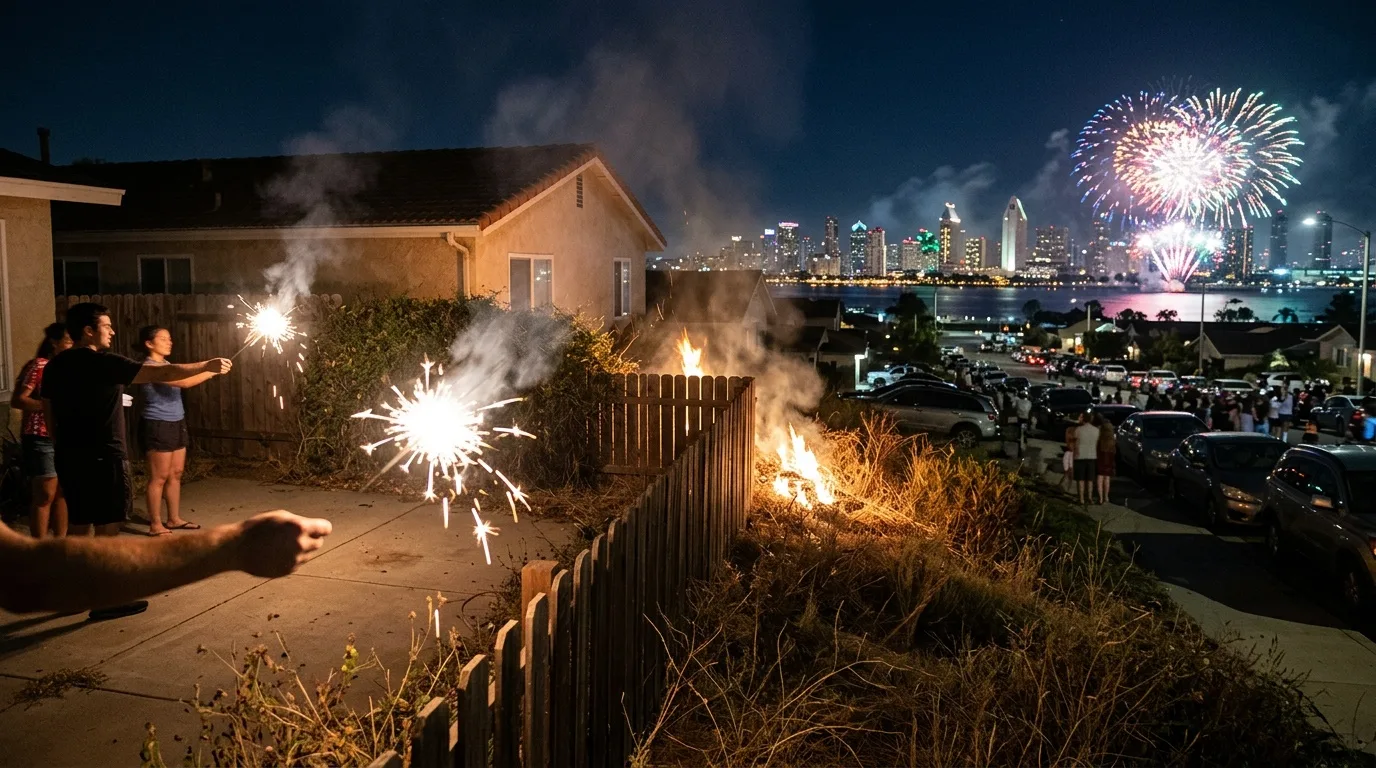
When the candles are lit and the celebration starts, it is worth thinking about how to keep something else from catching fire along with them. It helps to know where the real danger is with sparklers and fireworks, and where a homeowner should prepare in advance.
For San Diego there is a simpler first answer. The question of whether fireworks are legal in San Diego has a short reply, and the rest of this article is about why the rule exists: how fireworks start roof, palm and brush fires, what to do if something lands on your house, and what is left behind after even a small fire.
Are Fireworks Legal in San Diego? The Rule
According to San Diego Fire-Rescue's fireworks safety guidance, all consumer fireworks are illegal in the City and County of San Diego. So if you are asking whether fireworks are illegal in San Diego County, the answer is yes, and this is not limited to the loud ones.
- Sparklers. Illegal. Are sparklers legal in San Diego? No, even the ones sold as harmless for kids.
- Firecrackers. Illegal.
- Bottle rockets. Illegal.
- Poppers. Illegal as well, even these.
Professional shows are the legal way to see fireworks. That goes for fireworks in San Diego on New Year's Eve and for any other holiday. The fireworks laws in San Diego leave no category of consumer product that is allowed at home.
Why Fireworks Start Fires
Why do fireworks cause house fires? The two main dangers of fireworks are open flame and sparks that fly over a fairly large distance. Burning fireworks are hot enough to set dry plants, wood and fabric on fire.
Roof Fires
A firework that lands on a roof is most dangerous where something dry has collected: leaves and needles in gutters and roof valleys, dead palm fronds over the roof, an old wood shake roof, or an attic vent without fine metal mesh. Clear the gutters and the roof before the holidays and the dry season.
Palm, Brush and Yard Fires
On a property it is most often the vegetation that catches fire, not the buildings, so clear dry grass, branches, dead palm fronds and construction debris regularly.
In fire-prone parts of California, homeowners are required to keep "defensible space": a zone around the building that is free of combustible plants and materials. It lowers the risk of flame jumping from the landscape to the house when a ground fire comes close.
Vents in the soffits and under the roof get fine metal mesh that holds back burning embers and sparks. This is a detail that rarely made it into the plan of a private house before, but it is becoming standard in high-risk areas.
Dry Santa Ana Weather
Dry Santa Ana weather is exactly when the likelihood of fire is especially high. The reasons are heat, dry grass and open flame. Fires in natural areas can happen for much of the year.
Do not light any fire in windy weather, when sparks can be carried off. A spark caught by the wind does not stay where it fell. It can reach a roof, a balcony, an attic vent or a shed.
If Something Lands on Your Roof
If neighbors set off fireworks and they are flying toward your house, it is important to judge the situation quickly and act. Such launches are extremely dangerous and can lead to a fire or injuries. Step by step:
- Assess the situation. Figure out how close the fireworks are to your house and whether there is a real threat.
- Get people to safety. If anyone is on a balcony or in the yard, bring them inside right away. Close the windows and doors to keep out sparks and smoke.
- Remove things that burn. If you can, clear the balcony or patio of plants, holiday decorations, paper and anything else that can catch fire.
- Call 911. If the fireworks threaten a fire, call 911. Say what is happening and give the exact address.
- Talk to the neighbor if the situation allows. The point is not to start a conflict, but to calmly explain the danger.
- Do not go out or up on the roof. Watch from inside and be ready to evacuate if a fire starts.
After the incident, check your property and document any damage. If it keeps happening, report illegal fireworks to the police non-emergency line.
When you notice not only a fire but any sign of burning (smoke, the smell of something burning, a rise in air temperature), call 911 immediately. Describe what is burning, at what address and where exactly. Get people out. Only if there is no threat to life or health, start putting it out, taking precautions.
The CPSC's fireworks safety page has more on how fireworks injure people and start fires.
Smoke and Water Damage After a Small Fire
A fireworks house fire does not have to be large to leave a mess. Fires in houses happen not so rarely. But even after an event like this, it is important not to lose heart, draw the right conclusions and get your household back in order. For larger losses, see fire damage restoration in San Diego.
Washing off soot after a fire is a lot of trouble. Its structure and properties can differ. It all depends on the type of materials that burned and their burning temperature. So cleanup after a fire can vary a lot in time and method. In most cases, only a crew with special equipment gets the result you want. But cleaning up on your own is also possible. Here are several methods for removing soot from surfaces and furniture.
First, get personal protective gear: gloves, respirators, a head covering, clothes that cover as much of the body as possible, goggles. This keeps soot particles out of your airways, eyes and off your skin.
Then judge the scale of the job and buy the right cleaning products, cloths with different pile, scrapers, brushes and so on. Have plastic sheeting ready to cover furniture or the floor. After the preparation:
- Vacuum the walls. This picks up small soot particles and keeps them from spreading through the house later. Do not press the brush, just touch the surface lightly.
- Work from the top down. Treat surfaces with wipes or hand brushes.
- Remove what soot has soaked into. If soot got inside the material in some spots, cut it away with a putty knife, sander and so on.
- Mix a strong soap solution. Add a degreaser to it.
- Change rags often. Soot washes out of fibers poorly, so it is better to have a large supply of rags.
After the surface dries, you can paint it or apply another decorative layer.
Trisodium phosphate (TSP) is a common choice: two tablespoons in about half a gallon of water dissolve the greasy layer of soot.
When working with any cleaning products, protect the skin of your hands, never mix ammonia with bleach, and avoid breathing in chemical fumes and fine soot particles.
Water used to put out the fire is the other half of the damage. Wet drywall, flooring and cabinets need drying, which is what water damage restoration after firefighting covers. Belongings that took on smoke can be moved out and cleaned through pack-out services for smoke-damaged belongings; there is a separate guide on how packing out your home works.
You can read more about our restoration company, check reviews from San Diego homeowners, go back to San Diego water and fire restoration, or browse more fire and water safety articles.