

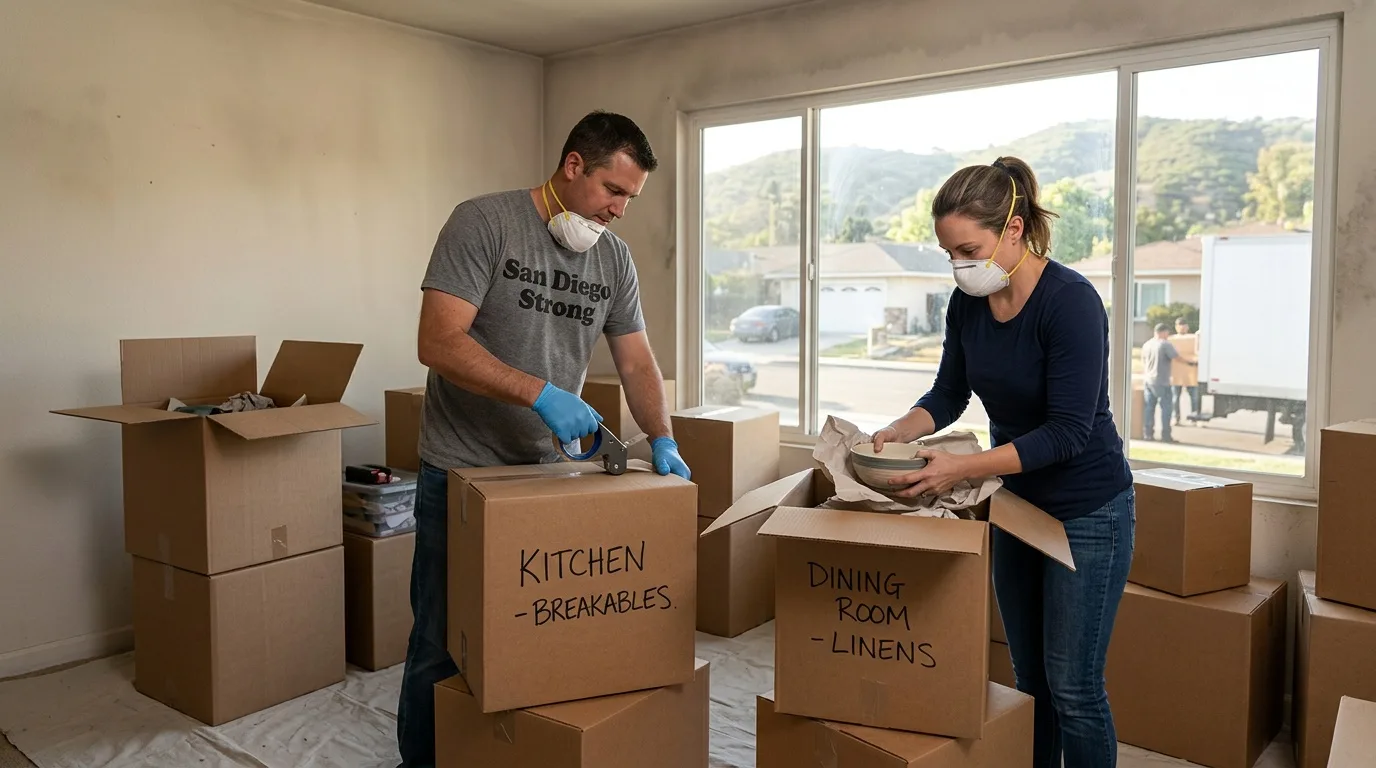
What is a packout and why it matters
A fire or flood can turn your home upside down in a matter of hours. Once the flames are out or the water recedes, you are left with a mess — soot on every surface, waterlogged furniture, the smell of smoke that seeps into fabrics and walls. Living in such conditions is impossible. Repair work cannot begin while the house is full of belongings. That is where a packout comes in.
A packout is the process of removing the entire contents of your home — furniture, clothing, electronics, documents, kitchenware, personal items — packing them up, transporting them to a secure facility, cleaning or restoring what can be saved, and eventually returning everything once the home is repaired. The whole point is to get your belongings out of the way so the restoration crew can work, and to give damaged items the best possible chance of being saved.
In San Diego, where wildfires and water damage from burst pipes or storm runoff are not uncommon, this service is something many homeowners end up needing at least once.
When a packout is necessary
Not every incident calls for a full packout. A small kitchen fire with limited smoke damage might only require spot-cleaning and airing out. But in more serious cases — structural fire damage, heavy flooding, or widespread contamination from soot and chemical residues — there is no practical alternative.
There are several situations when a full packout makes sense:
- The fire department used large volumes of water during suppression, and everything on the lower floors is soaked through.
- Soot and smoke have spread beyond the room of origin and coated surfaces, fabrics, and belongings throughout the house.
- Structural repairs are needed — walls, floors, or ceilings must be demolished and rebuilt, and items left inside would be further damaged.
- The home is unsafe to occupy during restoration, and belongings cannot simply stay where they are.
It is also worth noting that the aftermath of fire suppression often causes as much damage as the fire itself. Firefighters pour large volumes of water, sometimes mixed with chemical additives, to prevent smoldering and reignition. These streams can travel through floors and walls, reaching rooms far from the original fire. The runoff carries chemical compounds and soot residue. When this mixture soaks into furniture, carpets, and drywall, it is extremely difficult to remove without professional treatment.
The first step: inspection and damage assessment
Everything starts with a site visit. A specialist arrives, walks through the affected areas, and assesses the extent of the damage. Which rooms were directly hit by fire or water? Which ones suffered secondary damage from smoke, soot, or runoff? The inspector looks at walls, floors, ceilings, and every category of belongings — furniture, textiles, electronics, documents.
At this stage, photographic documentation of all damaged property is critical. Every room, every damaged item gets photographed. This record serves two purposes: it becomes the foundation for your insurance claim, and it helps the restoration team plan the scope of work.
An inventory list is compiled on-site. For commercial properties, this might follow a formal audit procedure. For residential homes, the list is simpler but no less important. You note what was damaged, how badly, and — if you have purchase receipts, warranty cards, or sales agreements — what it was worth. If receipts are missing, an appraiser can estimate value based on current market prices for comparable items.
One important rule: do not throw anything away and do not attempt repairs before the assessment is complete. Discarding damaged items before they are documented can undermine your insurance claim. The damaged state of your belongings is itself evidence.
Sorting: what can be saved and what cannot
Once the inspection is done, the actual sorting begins. Every item in the house falls into one of several categories.
The first category is items that are beyond saving. Heavily charred furniture, melted plastics, fabrics that have been soaked in contaminated water for too long — these go into the disposal pile. Burned debris, destroyed building materials, and anything that poses a health risk from toxic residue gets separated and removed.
The second category is items that need professional cleaning or restoration. This is usually the largest group. Smoke and soot particles are deceptively persistent — they settle on every surface, penetrate upholstery, get inside closed cabinets and drawers. Clothing and bedding need specialized laundering with industrial-strength detergents. Upholstered furniture requires deep cleaning, sometimes with chemical extraction methods. Hard furniture — tables, shelving, dressers — needs surface treatment to remove soot and neutralize odor.
The third category is items that are intact or only lightly affected. These still need to be packed and removed, because they cannot stay in a house undergoing major restoration work. Dust, demolition debris, and chemical treatments used during repair would damage them further.
Packing and removal
Packing for a disaster packout is not like packing for a move. Damaged items are fragile in unpredictable ways — a piece of furniture that looks fine may have weakened joints from water exposure. Fabrics smell of smoke and can transfer that odor to other items if packed together carelessly.
Salvageable furniture is disassembled where possible and wrapped in protective materials. Fragile items — glassware, ceramics, electronics — are packed individually. Everything is labeled and cataloged so it can be tracked through cleaning, storage, and return.
Burned debris and unsalvageable materials are collected separately. In San Diego, disposal of fire-damaged waste must follow local regulations. Certain materials — melted plastics, items containing chemicals, asbestos-containing materials from older homes — require special handling and cannot go into a standard dumpster.
The logistics depend on the scale of the disaster. A single-room fire might generate a few truckloads. A whole-house fire or major flood can require multiple trips with large vehicles.
Cleaning and restoration of belongings
This is the stage that sets a professional packout apart from just hauling things away. The goal is to return as many of your belongings as possible to usable condition.
Textiles and clothing
Clothes, curtains, bedding, and other fabrics that have been exposed to smoke require more than a regular wash cycle. Standard detergents do not break down soot compounds, and the smell of smoke bonds chemically with fibers. Professional cleaners use high-concentration detergents and sometimes ozone treatment to neutralize embedded odors. Items are sorted by material type, cleaned accordingly, and inspected before being stored.
Furniture
Soft furnishings — couches, mattresses, upholstered chairs — undergo deep extraction cleaning. Hard furniture gets surface treatment with specialized solvents that dissolve soot without damaging the finish. The gray-black film that settles on wood and laminate after a fire looks superficial, but it is actually a mixture of partially oxidized combustion products, synthetic resins, and carbon compounds. It bonds to surfaces and cannot be wiped off with household cleaners.
Electronics
Modern life depends on electronics, and fire does not spare them. Even if devices were not directly in the path of flames, they can suffer three types of damage. First, water used during firefighting causes corrosion on circuit boards and connectors. Second, soot and smoke residue change the conductivity of electronic components and can cause short circuits. Third, elevated temperature and humidity trigger chemical reactions in metals, oxidizing contacts and altering the operating characteristics of devices.
Cleaning electronics after fire is a painstaking, multi-step process. The composition of soot — a mix of partially oxidized combustion byproducts, synthetic resins, and carbon — essentially eats into the surfaces of circuit boards. Compressed air alone will not remove it, and most commercial cleaning agents would damage the components. Specialists use antistatic, electronics-safe chemical reagents designed specifically for this task. Boards may need to be dried from condensation and individually inspected for corrosion before the device can be reassembled.
Documents
Paper documents damaged by fire or water require careful handling. For water-damaged papers, the recommended approach is to freeze them first, then gradually dry them in controlled conditions to prevent warping and mold growth. Fire-damaged documents may still be partially legible and can sometimes be stabilized by a conservator.
Storage
While your home is being repaired, cleaned belongings need somewhere to go. Professional packout services use climate-controlled warehouse space designed for temporary residential storage. Items are organized by household, labeled, and tracked in an inventory system so that nothing gets lost and everything can be returned to the right place.
Storage conditions matter. Fluctuations in temperature and humidity can cause secondary damage — mold on leather, warping of wood, corrosion of metal components. A proper storage facility maintains stable conditions and may offer insurance coverage for items while they are on-site.
The length of storage depends on how long the repair takes. A minor restoration might be done in a few weeks. A full rebuild after a major fire in San Diego can take months. During that time, your belongings remain in storage, and you should have access to retrieve essential items if needed.
Working with your insurance company
The packout process and your insurance claim are closely linked. In fact, many homeowner policies in California specifically cover packout services as part of fire or water damage restoration.
The documentation you gathered during the inspection — photographs, the inventory list, purchase receipts — forms the backbone of your claim. The key documents typically include the fire department's incident report, any investigation findings, and the damage assessment report prepared by your restoration company or independent appraiser.
A critical point: do not start repairs or dispose of damaged property before the insurance adjuster has had a chance to inspect the damage, or at least before you have thoroughly documented everything with photos and video. If you throw away damaged items before they are cataloged, you may lose the ability to claim their value.
For San Diego homeowners, it is worth checking whether your policy covers the cost of temporary storage and professional cleaning of contents. Many standard homeowner policies do, but coverage limits and deductibles vary. Your restoration company can often coordinate directly with the insurer to streamline the process.
What San Diego homeowners should keep in mind
San Diego's specific risks — wildfire season, occasional heavy rains causing flash floods, and the ever-present possibility of plumbing failures in aging homes — mean that disaster preparedness is not optional. A few practical points:
- Keep a running inventory of valuable items in your home, with photos and receipts stored outside the house — in cloud storage or a safe deposit box. This makes the claims process far easier if disaster strikes.
- Understand your homeowner policy before you need it. Know what is covered under contents restoration and whether there are sublimits on categories like electronics or art.
- After any disaster, resist the urge to clean up or throw things away before professionals arrive. What looks like ruined junk to you might be restorable — and even what truly cannot be saved needs to be documented first.
- If a packout is needed, it should begin as soon as the property is declared safe to enter. Soot and smoke damage worsen over time. Water-damaged items develop mold within days. The faster items are removed and treated, the more can be saved.
A packout is not just about moving your stuff out of the way. It is about giving your belongings — and your life — the best chance of returning to normal after a disaster.