

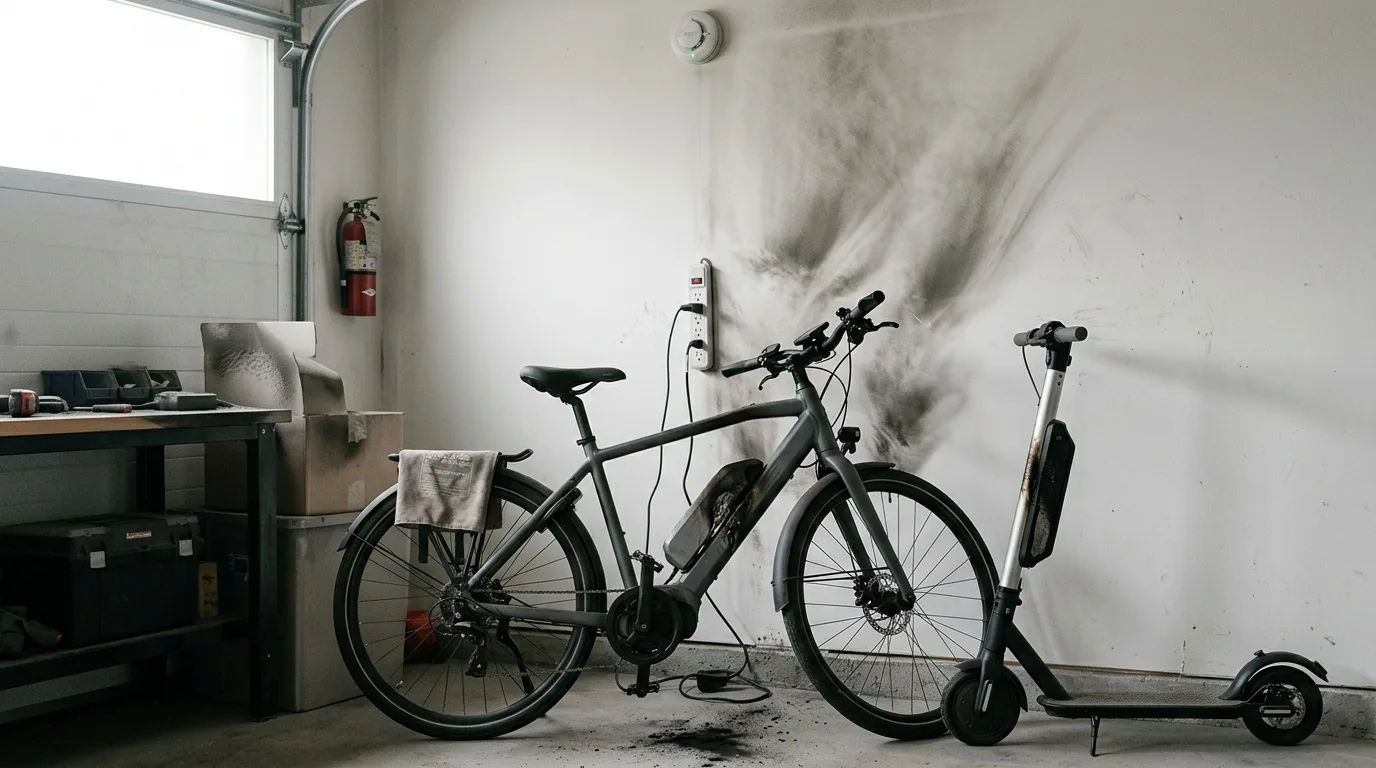
Lithium-ion batteries have earned a grim reputation as a fire hazard: while charging or in use, they can suddenly flare up and even explode. Batteries of other types — lead, sodium, nickel and others — are not as dangerous. The reason is the flammable electrolyte inside each cell.
An electric scooter is a convenient and affordable way to get around. But sometimes this two-wheeler can catch fire or even explode at the most unexpected moment, with tragic results. The most dangerous part of an e-scooter is its lithium-ion battery. It is the battery's chemistry that holds the potential threat of ignition. An e bike battery fire starts the same way.
In practice, scooters catch fire fairly rarely, but each time the consequences are serious. A scooter has a big battery, and putting it out yourself is practically useless, even impossible, because burning releases a huge amount of smoke.
Why Lithium-Ion Packs Fail
Why it is bikes and scooters that burn
Lithium-ion batteries are fitted to many devices, from wristwatches to electric cars. Yet the ones that show up in the news most often are light vehicles — electric motorcycles, scooters and bicycles — and phones or cars much less often.
Why is that? It comes down to two reasons combined. On one hand, two-wheelers carry fairly powerful batteries with strong electric currents inside. A phone battery is under much less load. Of course, the battery of a small gadget can catch fire too, but since it is small, the harm from the fire is much smaller.
On the other hand, oversight of these small mobility devices is not very strict. Electric cars also have powerful, heavily loaded batteries, but their quality is checked carefully at the factory.
On top of that, the battery works under strong vibration and risks damage when the bike or scooter falls.
How thermal runaway happens
In every case the battery catches fire following one and the same scenario, which engineers call thermal runaway.
Inside a damaged or overheated cell, the chemicals start breaking down and give off heat and flammable gas. The heat breaks down even more of them and spreads to the next cells, so one failing cell can set off the whole pack.
Most often thermal runaway happens during charging. But it can also happen when the battery works under heavy load, when it heats up a lot as well.
Defects, home tinkering and the wrong charger
One of the most common causes of e-scooter fires is a defective battery pack.
A burning battery can fill a room with smoke within seconds. If a scooter or e-bike catches fire, being in that room is dangerous — do not try to put it out yourself.
- Poor assembly at the factory. Most often scooters catch fire because of low-quality battery assembly at the manufacturer: either poor cells were used, or there was a soldering error, or the safety boards were defective. There are quite a few makers on the market with weak quality control at the factory exit.
- Do-it-yourself upgrades. Owners often try to "pump up" their gadget on their own. Wanting to add extra equipment (horns, lights and so on) and improve its specs (speed, battery capacity), they get into the scooter's design without understanding what they are doing. During such an "upgrade" the circuits of the electronic parts can be damaged, which later leads to the power unit overheating and catching fire.
- Poor-quality repair. It is better not to fix a scooter with your own hands or go to unverified repair shops, where unqualified staff may work.
- A charger that isn't the original. Alternative chargers may not match the charging port's specs. In other words, the battery simply cannot take as much current as the "foreign" charger puts out — overcharging happens, and that threatens a fire.
- Mechanical damage and no waterproofing. Scooters are not made for jumping off curbs. Any mechanical damage to the circuits inside the device can lead to a short circuit during charging. Corrosion caused by a lack of waterproofing can lead to the same thing.
- Improper storage. Temperature swings and changes in humidity can cause condensation, which in turn causes corrosion in the circuits or in the power unit.
Charging a damaged battery is one of the main causes of gadget explosions. That is what can lead to a short circuit, overheating, explosion and other unpleasant outcomes. But there can be other causes too: mechanical impact on the battery (a blow, a puncture), factory defects, and improper use — including, for example, a long, deep discharge of the battery.
Warning Signs: Heat, Swelling, Smell
Lithium batteries handle charging at low temperatures very poorly. If you come in from the cold and plug the battery in right away, a process of lithium plating can start inside — in the long run it leads to a short circuit in the cell. Wait until the battery has warmed to room temperature, and only then connect power.
If you notice that the battery case has started to bulge suspiciously, stop charging at once. That is a clear sign of a swollen battery. A battery like that should not be kept at home, and you should certainly not try to "press" it back. Take it to a household hazardous waste drop-off or a battery recycler as soon as possible. The same goes for a damaged or badly dirty charging port. If the plug goes in poorly or falls out, it is time to pay attention to the device.
Heat that builds up while charging is another signal. If the battery is covered, a thermos effect is created: heat accumulates, the controller cannot cut power in time, and the battery starts to degrade — or, worse, swell. In the worst combination of circumstances it catches fire, and putting out such a flame, with its acrid smoke, is hard. A sharp chemical smell near the charger is reason enough to unplug.
If your scooter or bike has fallen, inspect the battery, make sure there are no cracks on it, and start using it carefully, at low power.
Charging and Storage
In short, you need to choose devices with care when buying and then handle them gently.
Fires happen most often with cheap uncertified devices. There is logic in this. Makers of knock-off cheap batteries cut costs every way they can — they make thinner cases, don't check that the electrodes are the right shape, don't build in temperature sensors. Manufacturers who watch quality, by contrast, provide good protection against impacts and damage to the case. They control electrode uniformity in production — hot zones most often form exactly at non-uniform spots. The battery will have a management system for charging and operation that adjusts charging power if the temperature becomes dangerously high.
UL Standards & Engagement battery safety tips advise buying batteries and chargers evaluated to UL 2849 or UL 2272, and never charging near an exit. The CPSC's e-bike and e-scooter safety page adds its own rules.
- Buy from proven brands with good reviews. Don't buy the first device that comes along.
- Stay present while charging. Per the CPSC, never charge while you are asleep or away from home.
- Use only approved chargers and batteries. Use the charger and replacement batteries approved by the device maker. Don't use a more powerful charger than the standard one.
- Unplug when it's full. Don't leave the device connected to the outlet long after the charge has reached 100%.
- Don't cover the battery. In the heat, don't ride at top speed, and when charging, don't pile things on the battery.
- Keep the exit clear. If you charge a scooter or e-bike in your home, do it so that in case of fire it does not block your way out.
- Service only at proper shops. Have maintenance done only at authorized service shops. Don't repair or "upgrade" the scooter yourself.
- Store it dry, at room temperature. Keep it in a dry room with a stable room temperature; check the maker's manual for its storage range. Keep it away from a heater, and not on a balcony or patio where temperatures swing.
- Keep water away. Moisture that gets into a connector under voltage causes instant electrolysis and corrosion of the contacts.
- Dispose of old batteries correctly. Never put lithium batteries in the trash or the recycling bin.
A fireproof charging box or bag can add protection, but it does not replace the rules above. And teach these rules to your kids — children, who don't yet know how to handle equipment carefully, can get burns from a battery that suddenly flares up.
If It Smokes: Get Out, Call 911
If you see smoke or fire on the device, unplug it from the charger right away, if you can do it without risk. If a larger device such as a scooter or an e-bike has caught fire, evacuate immediately and call 911. Don't try to put it out yourself.
Lithium-ion batteries release toxic substances when they burn, and breathing them is dangerous to life. That is the main lithium battery fire health risk, and it is why the room should be left at once rather than fought for.
Smoke and Soot After a Battery Fire
Scooter battery fire damage often goes far beyond the spot where the pack burned. At the moment of burning a huge amount of smoke is released, and within seconds it fills the room. That smoke carries the same toxic substances, and it settles on walls, ceilings, furniture and belongings. A home where this happened should not be lived in or cleaned without care.
The fire and smoke damage restoration process deals with soot and odor left on surfaces. Belongings that need cleaning away from the house can be handled through contents pack-out and storage services; our practical guide to packing out a San Diego home describes how that works. Water used to fight a fire can leave dampness behind, which is where mold remediation after fire suppression water may come in.
You can read more about our restoration team, see what San Diego homeowners say in reviews, find more articles in the restoration news and tips blog, or return to our restoration home page.