

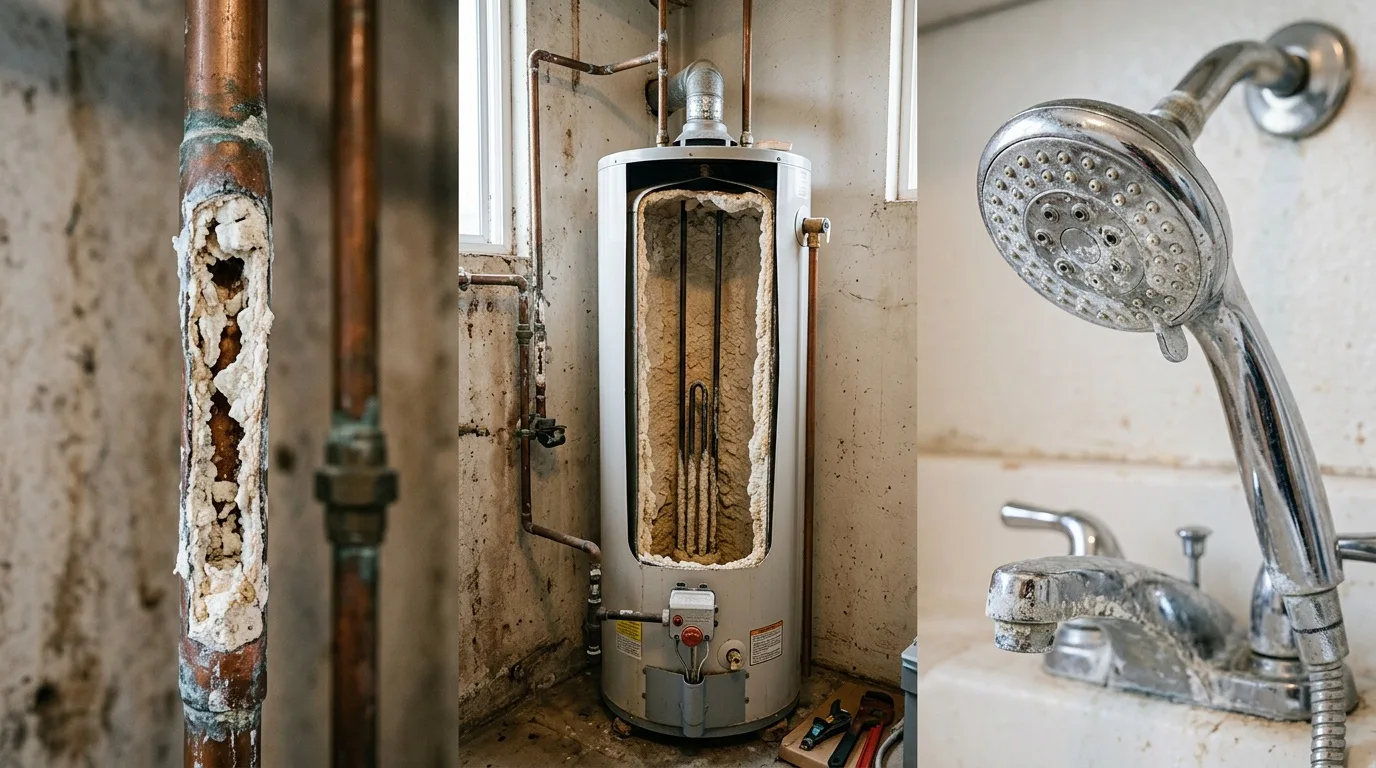
White crust on the shower head and streaks on the faucets are the most common signs of hard water. But the problem is more serious than that.
The same deposit forms inside the plumbing and inside appliances: the washing machine, the dishwasher, the coffee maker, the water heater. According to the City of San Diego water quality page, drinking water here averages about 16 grains per gallon (276 ppm) of hardness, and the figure varies by area and by demand. Below is why water is hard, how to tell, what scale does to pipes, valves and the water heater, and what can be done about it.
What water hardness is
Hardness shows how many dissolved salts are in the water, mainly calcium and magnesium. The USGS page on water hardness puts it the same way: hardness is mostly dissolved calcium and magnesium. If there is a lot of them, the water is considered hard. If there is little, it is soft.
Total hardness is the sum of two values, temporary and permanent hardness.
- Temporary, or carbonate, hardness. It is called that because of calcium and magnesium bicarbonates, and it can be partly removed. Water gets softer when it is heated or boiled. The bicarbonates break down, but they form an insoluble deposit, which is scale.
- Permanent, or non-carbonate, hardness. It comes from sulfates, chlorides and other calcium and magnesium salts, and heating or boiling does nothing to them.
Signs of hard water at home
You can tell the water is too hard by outward signs:
- Streaks on fixtures. Whitish runs on the sink, the tub and the toilet.
- Spots on dishes. Marks that show up after the dishes dry.
- Scale on heating parts. Deposits on the heating elements of appliances or, for example, on the walls of pots.
- Dry skin and hair. A dry, flaky, itchy feeling after a shower, and brittle hair that is hard to comb.
- Rough laundry. Clothes feel stiff to the touch after washing.
- Bitter tea and coffee. A bitter taste and a cloudy film on the surface.
- Soap that does not work. Soap and dish liquid lather poorly. Calcium and magnesium salts neutralize detergents, so you end up using more of them.
Weak flow at the faucet and the shower head
Scale in water pipes makes the pipe narrower, and the water pressure drops.
The shower head clogs mostly because of hard water. There is a lot of calcium and magnesium in it, and they collect around the holes of the spray plate and form deposits. When there are a lot of deposits, the water starts spraying in different directions.
The aerator can clog too. That is the tip on the end of the faucet that makes the stream even and saves water. Finding where the problem is is simple: if the flow is weak at only one faucet, the aerator screen is clogged. If the flow is weak at every faucet, most likely the problem is in the line coming into the home, and that is a job for a plumber.
You can clean the aerator yourself. Unscrew it from the faucet, usually by hand, though a wrench may be needed if it is on tight, and scrub it with an old toothbrush until the deposits fall off. The shower head is cleaned the same way:
- Rinse. Rinse the head under running water.
- Brush. Clean the face with a toothbrush.
- Clear the holes. Poke each hole with a toothpick or a pin to remove the deposits.
If the water is hard, it is worth doing this every month. Otherwise go by the situation: if the water runs poorly, it is time to clean.
A noisy, slow water heater
Over time, calcium and magnesium salts settle on the heating element, and a crust forms inside the tank. As it builds up, it clouds the water and keeps the unit from working normally.
The water heater itself can let you know something is wrong. Sometimes it starts making a lot of noise, power use goes up, and heating the water takes longer. The water may heat poorly and turn cloudy. Meanwhile the tank itself is hot. In some cases it switches on and off at random.
Scale on heating elements lowers their heat conduction. As a result, appliances use more electricity, overheat and break down sooner.
Does hard water damage pipes, valves and supply lines?
Hard water shortens the life of faucets and of the fill and flush valves of the toilet. Hard water damage to pipes and fixtures shows up first at the valves and cartridges.
- Toilet tank. If the owners are away for a long time and the water is hard, a solid deposit can form inside the toilet tank and get in the way of the mechanism. Household cleaners will not remove it, and a plumber has to clean it.
- Fill valve. Lime builds up on the valve gasket. After a flush the valve cannot close all the way, and a thin stream of water keeps running into the bowl. This should be fixed right away, because it only gets worse: the valves will clog more, and more water will run out, and that water costs money.
- Faucet cartridges. Faucets have cartridges that mix hot and cold water in the right proportion. When they fail, the faucet starts to drip. Then the cartridge has to be replaced. Do not wrap the faucet in tape or invent other ways around the problem without replacing the part.
A dripping faucet is not dangerous in itself. Many floods in homes happen because a flexible supply line bursts, the braided hose that connects a fixture to the pipes. A flexible supply line does not last forever, and how long it lasts depends on the maker. There is no reliable way to prevent trouble with them. Their life can be extended with pressure reducers and a water hammer arrestor. But if you notice that the hoses have started to weep, it is better to replace them right away. Such damage can also come from installation mistakes, for example when the hose was screwed on too hard.
When a supply line does let go, the water rarely stays where it started. This is the work covered on our water damage restoration service page, and water left in walls and under floors is how a leak turns into a mold remediation job in the home.
Can scale lead to a water heater leak?
Old heaters, and units that run on water with a high mineral content, are prone to corrosion, which eats the metal of the tank from the inside and can lead to leaks or to the unit failing.
Water softeners and their own leaks
The most reliable way to beat hard water is a whole-house filter with a softener. It is installed where the supply pipe enters the home, so it treats all the water, both drinking and household, and softens it. Softening happens through ion-exchange resin: as hard water passes through, the resin holds the calcium and magnesium ions and releases sodium ions into the water. The resin is renewed from time to time with a salt solution.
The downside of a whole-house system is that it is fairly bulky and, as a result, it suits houses better than apartments. Soft water in San Diego can also be had in smaller steps:
- A pitcher filter. The simplest filter, most effective with cartridges made for hardness.
- An under-sink filter. A reverse osmosis unit takes time to install, but it lowers hardness and also cleans the water of various compounds, and it has a tank of treated water in reserve.
- Appliance additives. Detergents and rinse aids made for hard water help the dishwasher and the washing machine.
A whole-house softener is plumbing like any other part of the line, with a housing, fittings and hoses. The same rules as for supply lines apply to its hoses: pressure reducers and a water hammer arrestor extend their life, overtightening at installation damages them, and if a water softener is leaking at a hose, that hose should be replaced right away.
Flushing the water heater
Over time, minerals and sediment from the water collect in the water heater. They settle on the bottom of the tank and cause problems:
- Slow heating. The heater warms the water more slowly.
- Higher bills. It uses more electricity or gas.
- Extra load. It works under heavier strain.
- Shorter life. It wears out faster and can break down.
Regular flushing helps keep the water temperature steady and lower utility costs.
How often to flush
- Tank heaters, electric or gas. Often once a year; check the maker's manual for your unit. The steps are similar for both types; the only difference is how the power is shut off.
- A tankless water heater. There is no tank, so a tankless unit is cleaned with special equipment and solutions, usually by calling a plumber.
How to flush a tank heater yourself
- Turn it off. Switch off the water heater, close the cold water supply valve to it and let it cool down.
- Relieve pressure. Open a hot water faucet to lower the pressure.
- Attach a hose. Connect a garden hose to the drain valve at the bottom of the heater.
- Route the hose. Lead the hose to a floor drain, a container or outdoors.
- Drain. Open the valve and let out all the water with the sediment.
- Rinse. With the drain valve still open, open the cold water supply for a few minutes to wash out what is left of the sediment, then close it.
- Refill. Close the drain valve, disconnect the hose and open the cold water supply valve. Keep a hot faucet open until water runs from it without spurts of air, then close it.
- Power on. Only after that turn the power or the gas back on.
If the water is cloudy or sandy while draining, that is normal. That is what the sediment that kept the heater from working well looks like.
If flushing did not help and the water is still cloudy, ask a plumber about descaling; solutions of citric acid or vinegar are often used. Harsh chemicals and solvents are not recommended: they are a health hazard, they attack the inner surface of the tank and they can damage the heating element.
Do not experiment if the water heater is old or has not been serviced in a long time, if you do not know how to shut off the gas or the electricity correctly, if the unit is leaking or the water is rusty, or if the drain valve will not open or is stuck. In these cases calling a plumber is safer and cheaper than fixing a serious breakdown.
More reading on this site
If a leak has already reached the lower level of the house, read what to do first when a basement floods. When belongings have to come out of a wet room, see the pack-out and contents services page. You can read more about our restoration company, look through reviews from San Diego homeowners, browse other articles in our news section, or go back to the home page of the site.