

A leaking water pipe is one of the most unpleasant things that can happen in a house. It is worse when the leak is hard to find, because the faulty pipe sits inside a wall, under the floor or somewhere you cannot reach. Often the first thing a San Diego homeowner notices is not water at all but a high water bill. A leak behind a high water bill can run for weeks before any stain shows up.
Below is how to check for a leak with the water meter, how to test the toilet tank, where hidden leaks usually hide, and what the City of San Diego looks at when you ask for a leak adjustment.
Why the Water Bill Jumped
Check whether the amount on your water bills has changed by comparing how much water you used over a long stretch of time. If at some point the usage went up, while the number of people living in the house stayed the same, this is most likely a sign of a leak.
Hidden water leak signs also include the following:
- Unexplained growth in water use. The bill climbs, and your habits have not changed.
- Lower pressure. A noticeable drop in water pressure, or less water coming out of the taps.
- Changes in the water. Rust, dirt or air suddenly appearing in the water that comes into the house.
- Wet spots outside. Unusual damp spots in landscaped areas, or water collecting on the surface of the ground.
- A patch that stands out. An overgrown, moldy, soft or mossy area surrounded by drier ground.
- Cracks and settling. Cracked or heaved concrete or asphalt, sinkholes, an uneven floor slope or a building that has shifted.
If you see any of these signs at your property or in your house, you may have a water leak. The meter will tell you more.
The Water Meter Leak Test
Every building that gets water has a water meter. The charges for water and sewer on your bills are based on its readings. Knowing how to read the meter makes it easy to check for a leak.
Find and Open the Meter
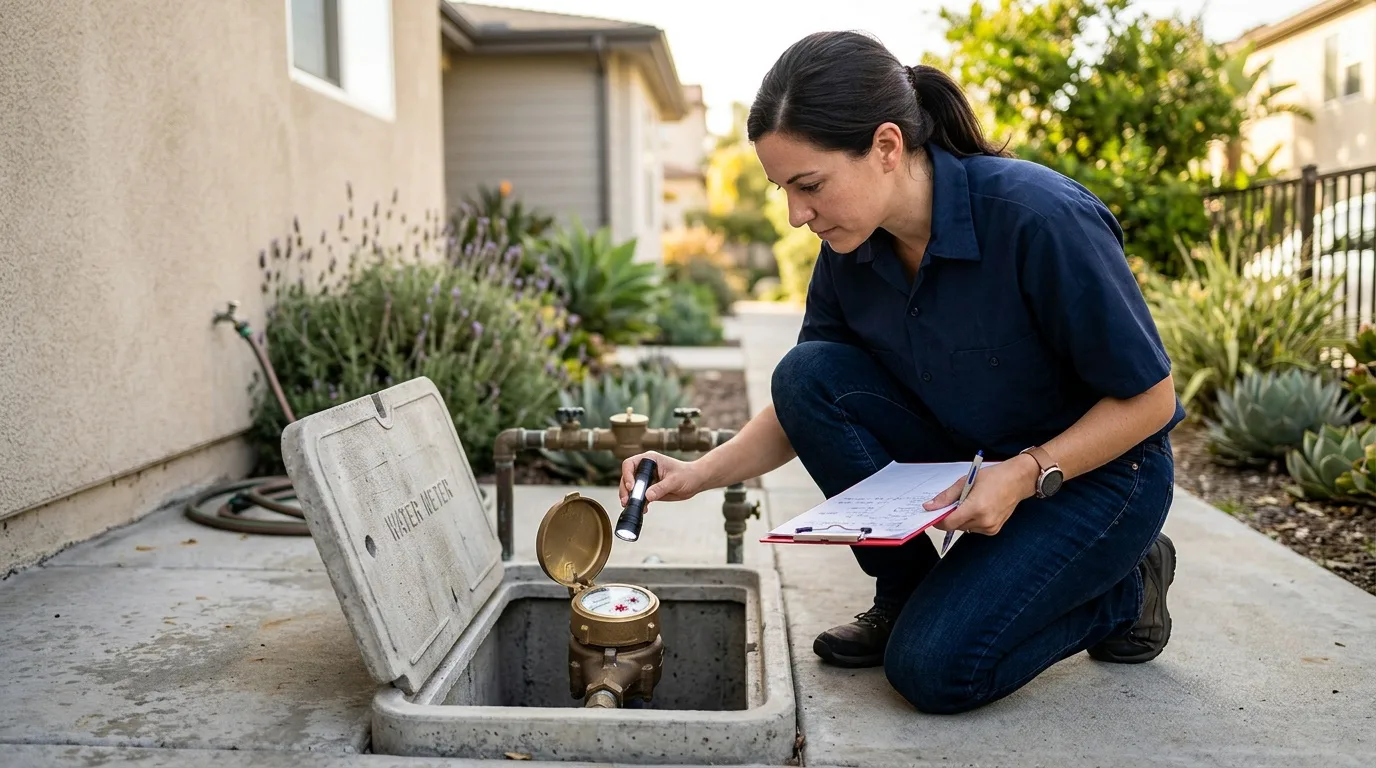
At a house, the meter is usually set in the ground near the curb in front. The meter box is often covered with a metal or plastic lid marked "Water Meter" on top.
To read the meter, lift the lid of the box. Be careful. The lid can be heavy. Insects and small animals sometimes hide under the lid. When you finish reading the meter, close the lid for safety.
Most residential meters have a leak indicator. It may be a red or blue triangle, or a blue snowflake. If water is leaking in a stream, it can spin fast. If water is leaking drop by drop, the leak indicator may turn slowly.
Run the Test
- Do not use water. Turn off water everywhere in the house and outside, including the shower, sinks, washing machine, irrigation and any other appliance that uses water.
- Carefully open the meter box. Write down the numbers or take a photo of them.
- Watch the meter. If your meter has a triangular blue or red "leak indicator" and it is spinning, you may have a leak. If there is no leak indicator, but the sweep hand of the meter itself moves, water is being used somewhere in your system, and you may have a leak.
- Wait and check again. If the hand is not moving, mark where it is and wait a few hours, making sure no water is used anywhere in the house or yard. Then check the meter again. If the hand has moved, you may have a slow leak.
The rule from the EPA WaterSense leak-check guide is the same: if the meter changes at all during a two-hour period when no water is being used, you probably have a leak.
How to Find a Water Leak from the Meter to the House
If there is a leak, you need to work out where it is happening: inside the house or outside.
- Find the shutoff valve. Locate the valve on the pipe that brings water into your house. It is usually where the pipe enters the house: outside next to a hose bib, or in the garage.
- Close the valve.
- Check that the valve works. Open a faucet in the house. If water still comes out of the faucet after a few seconds, the valve is not working, and you cannot tell whether the leak is in the house or outside. If no water comes out, the valve is working. Go back to the meter.
- Check whether the leak indicator or the dial hand is still moving. If it is, water is being used between the meter and the valve on the pipe into the house. This means there may be a leak between the shutoff and the meter, most likely underground. If the leak indicator does not move, the leak may be somewhere in the plumbing inside the house. The source could be a toilet tank, a faucet, an appliance or even a garden hose.
This is the simplest way to find a leak you cannot see: the meter narrows it down to the yard or the house before anyone opens a wall.
The Dye Test for the Toilet
A toilet tank often leaks quietly, and the meter test does not always catch it, because the tank refills now and then. The EPA WaterSense guide suggests a separate check: put a few drops of food coloring in the toilet tank and do not flush. If color shows up in the bowl within 10 minutes, you have a leak, usually a worn flapper.
Where Hidden Leaks Hide
The Toilet Flapper and Tank Parts
In many cases the toilet tank itself is to blame. The causes can differ:
- The flush button or handle. It either sticks, or it is hard to press and slow to return.
- The float. It may have a crack, or its mount may be broken.
- The rubber seal at the bottom of the tank. Over time it wears out, and gaps form through which water runs.
- The overflow height. If the water level is set too high, you will see water slowly running into the overflow opening and from there into the bowl.
- The flexible supply hose. It can have a defect.
To see which one it is in your case, take the lid off the tank and look at the water level. If the rubber seal is simply covered in dirt, clean it with warm water and vinegar. If it is worn, the part should be replaced.
Irrigation and the Yard
Poor performance of the irrigation system is one of the signs of an underground leak, along with wet spots in landscaped areas and water pooling on the ground. If the meter test points outside, walk the yard and look for a patch of grass that is greener or softer than the rest.
Under the Slab
A leak in a buried pipe can be caused by many things, including corrosion, root intrusion, a failed glue joint or structural damage. It can also come from ground movement or even rodents. Pipes of any material can leak, including copper, steel, iron and PVC. Under a slab, the signs are the same as above: an unexplained jump in use, lower pressure, an uneven floor. Repairing a slab leak is work for a plumber, and it is a separate topic.
Inside a Wall
The first sign is, of course, collecting water. Check whether there is a spot in the house where you always find a small puddle or where the carpet gets wet. Make sure the water could not have come from an appliance, such as the refrigerator. Also remember that puddles form in the bathroom next to the sink or the shower. Once all of these are ruled out, it is likely that the pipe in the wall is leaking.
Look at the walls. As a rule, a leaking pipe makes moisture come through the wall, and the paint, drywall or wood paneling at that spot changes color. If you see lighter or darker spots of irregular shape, most likely a pipe is leaking behind the wall. The texture of the wall changes too: paint bubbles and drywall sags from too much moisture.
Mold is one of the signs that a pipe in the wall is leaking. If you smell mold or notice it on the wall, the leak needs to be dealt with. Keep in mind that at early stages mold can look like clusters of black or brown dots.
The sound of dripping inside the wall can also point to a leak. Turn off the loud appliances in the house and listen carefully.
What the City Counts as a Concealed Leak
According to the City of San Diego leak adjustment page, an adjustment is considered only for a concealed pipe leak that is not part of irrigation. Leaks from irrigation, pools or fixtures do not qualify. That means a running toilet flapper or a broken sprinkler line will not count, even if the bill was large. A San Diego water leak adjustment is about a pipe you could not see: inside a wall, under the floor, in the ground.
The request must be made within 120 days of the first high bill. The City's review takes about 6 to 8 weeks.
What to Keep for the Request
Keep the paperwork from the start:
- The repair invoice. It should show what was leaking and where.
- The dates. When the first high bill arrived, when you found the leak and when it was repaired.
- Meter readings. The numbers or photos from your meter test, before and after the repair.
- The bills. The high bill and the bills before it, so the jump in use is easy to see.
Drying After the Repair
Fixing the pipe does not dry the wall. Drywall, insulation and the floor under it keep the water they absorbed. Constant dampness lets mold grow, and its spores are not safe to breathe.
Mold can be very dangerous to health. If it has appeared on a wall where a pipe was leaking, do not touch it bare-handed: have it removed right away by someone wearing gloves and respiratory protection, and do not leave the wet materials closed up.
For a small damp patch, a dehumidifier and a fan aimed at the wall help.
When the water got deep into a wall or under flooring, household fans are not enough. That is the job of professional water damage restoration in San Diego, where the hidden moisture in walls and floors is dried with equipment. If spots have already appeared, mold remediation for affected walls is a separate step. When a room has to be emptied for the work, furniture and boxes can go out through pack-out and contents storage services.
A leak that reached the lower level of a house can look like a flood. For that case, read our guide on the first steps after a flood. More about who does the work is on the about our restoration team page, and homeowners' feedback is on the customer reviews from local homeowners page. Other articles on water, fire and mold are in the blog with more homeowner guides, and the services are listed on the restoration company home page.